
Frequently asked questions
What buyers and sellers ask us most, collected in one place.
Straight answers, including the ones that do not flatter us.
These questions are collected from the buying and selling pages and from our guides. Under each group is a link to the page where the subject is worked through in full.
Buying a property
EU citizens buy without any restrictions, exactly like Croatian citizens. Non-EU citizens need consent from the Ministry of Justice based on reciprocity, or buy through a Croatian company. We guide you through either route.
Roughly 4 to 5% extra: the 3% transfer tax, notary and land registry fees, and a lawyer. The agency commission is agreed up front, before the first viewing.
From agreement to signing usually takes two to four weeks, and with tax and registration the whole process takes four to eight weeks. You normally receive the keys right after payment.
No. With a power of attorney certified by a notary or at a Croatian consulate, we can complete the entire process without you travelling.
Clean 1/1 ownership, liens and mortgages, cadastre and land registry alignment, and building and usage permits. If something is not clean, you will hear it from us, before the offer.
Yes, with a categorization permit. The procedure is standard and we help you start it after the purchase.
Selling a property
The commission is set in the brokerage agreement before we start, transparently and with no hidden costs. It is paid by the party who engaged us, as agreed.
Realistically priced properties on Pelješac usually sell within six to twelve months. Overpriced ones sit for years, which is why we start with an honest valuation.
We solve that before listing. We check ownership, liens and permits, and sort out what is missing with a lawyer, before a buyer ever asks.
Yes. Part of our portfolio is offered only to vetted buyers from our database, with no photos on portals and no curious neighbours.
A legalised house in Croatia: what the rješenje o izvedenom stanju means
For everyday use, nearly. A building with a rješenje o izvedenom stanju counts as an existing building and may be used, reconstructed and connected to infrastructure. The difference is that an occupancy permit follows a technical inspection of works built to a design, while legalisation relies on a survey of what exists, so build quality needs checking separately.
Yes. The act provides that a building with a rješenje o izvedenom stanju can receive a decision allowing a business to be run in it, which is the basis for categorisation. The condition is that the decision covers all the space being let, including any apartments added on the ground floor.
Yes, through the normal procedure. A legalised building counts as existing, so a reconstruction or extension needs a building permit under the current spatial plan. What the plan does not allow today cannot be added just because the rest of the house is legalised.
Yes, if it was visible on the digital orthophoto map from aerial survey begun on 21 June 2011. Amendments in force since 16 May 2026 abolished the application deadline, which had previously expired on 30 June 2018. Applications are made electronically through the eDozvola system.
Yes. When a legalised building is entered in the land registry, the court adds a note to the possession sheet, of its own motion, that a rješenje o izvedenom stanju was submitted, with the name and reference of the act. If the building is registered and there is no such note, it is worth asking on what basis it was entered.
Selling property in Croatia: tax, costs and what you actually keep
As a rule, no. Gain on the sale of property is taxed if the property is disposed of within two years of acquisition. After that it is not taxed, however much the value has risen. The period runs from the date of acquisition, not from moving in or from registration, so that date is the first thing to establish.
The buyer. The 3 percent real estate transfer tax is the buyer’s obligation and the seller does not pay it. This is the most common confusion among sellers, who sometimes deduct that amount from their own calculation although it does not concern them. The seller’s tax is a different thing entirely, income tax on the disposal of property.
You do. Obtaining an energy certificate is the seller’s obligation, not the buyer’s, and it accompanies the listing and is handed to the buyer. It is valid for ten years. There is a fine for not having one, so it is dealt with before advertising rather than in the week of signing. You order it from an authorised assessor.
Inheritance in itself is not a taxable acquisition for the purposes of this tax, but the date and value of acquisition decide whether a later sale is taxable and on what base. For inherited houses on Pelješac this is the single most important question, and the answer depends on when and how the property entered your estate. Check it with a tax adviser before you set a price.
Gain on real estate is as a rule taxed in the state where the property is located, meaning Croatia, and that applies regardless of where you live. Your home country will usually take the same gain into account but, through the double taxation treaty, credit what was paid in Croatia. You need a Croatian tax number for all of it, and the process is run by a tax adviser in both states.
If you are selling after two years and the paperwork is in order, the deductions are small: commission per the agreement, the energy certificate and obtaining documents. If you are selling within two years, or the paperwork is not sorted, the difference can be substantial, because tax and the cost of reconciliation both appear. Which is why the net figure is calculated before setting a price, not after the first offer.
Cadastre and land registry in Croatia: how to read the extract
It is not, and the document says so explicitly. A possession sheet from the cadastre shows who holds the parcel and how it is used. Ownership is proved only by the land registry extract. When a seller offers only a possession sheet, it usually means somebody else is in the land register, typically an ancestor who died long ago.
Yes. The land register is public and browsing it is free through the joint information system at oss.uredjenazemlja.hr. All you need is the cadastral municipality and the parcel number. That printout is not certified and cannot be used as a document in proceedings, but for deciding whether to travel for a viewing at all it is entirely sufficient.
You buy a parcel identified by number, not a specific number of square metres, so a difference in area does not by itself break the purchase. But the contract, the tax return and the price per square metre are all written from one figure, so which one is real has to be settled before signing. In the old cadastral municipalities on Pelješac such differences are common, because the survey dates from the Austrian one.
It means an application has been filed that the court has not yet decided. Because an entry takes effect from the moment the application arrives rather than from the decision, this mark is the only item on the extract that tells you something about the future. Until you know what lies behind it, you do not know what you are buying. Check it again on the day of signing, not only on the day you obtained the extract.
It is solvable and very common on Pelješac. The land is registered but the building on it is not, because nobody ever recorded it. The route runs through a geodetic report for recording the building, entry in the cadastre and a notification to the land registry, together with the documents proving the building is legal. What matters is that it is resolved before payment rather than after, because afterwards you have no leverage.
It depends on the workload of the land registry department and runs from a few weeks to a few months. Your protection does not begin with the decision but with the arrival of the application, because priority ranks from that moment, so the application is filed as soon as signatures are certified. You normally take the keys on payment, not on completed registration.
Buying from heirs in Croatia: how an unsettled estate gets resolved
Not directly. Ownership passes to the heirs at the moment of death, but until there is a final decision on inheritance nobody is registered as owner, so there is no tabular declaration and no registration. In practice you sign a preliminary contract with all the heirs, the deposit goes into a lawyer or notary escrow, and a deadline for settling the estate is agreed. You do not pay the full price before registration.
Where every heir is known, reachable and in agreement, usually a few months. If someone lives abroad, add time for the power of attorney and for service of documents. If an heir has themselves died in the meantime, their estate has to be settled too, and then the timescale is measured in years. The notary handling the file gives the realistic estimate for that specific case.
Then the property cannot be sold as a whole. Three routes remain: the other co-owners buy out their share, that heir buys out the others, or a partition of the co-ownership is started. Partition through the courts is slow and can end in a public sale below market value, so a negotiated settlement is almost always cheaper for everyone.
An heir abroad takes part through a certified power of attorney, with an apostille or certified at a Croatian consulate, and does not need to travel. If the address is genuinely unknown, the court can appoint a temporary representative and the proceedings continue without them. That lengthens the timeline but does not stop it.
A spouse and descendants or ancestors in the direct line are exempt from inheritance tax, which covers the great majority of family cases. For other heirs the rate is 4 percent. When you then buy from the heirs, you pay real estate transfer tax exactly as in any other purchase, which our guide to the costs of buying sets out.
This happens often with old parcels that nobody declared because nobody knew about them. The whole procedure is not repeated: a supplementary decision on inheritance is issued for the newly found property. What matters is that the heirs are the same and still reachable, otherwise you are back at the beginning.
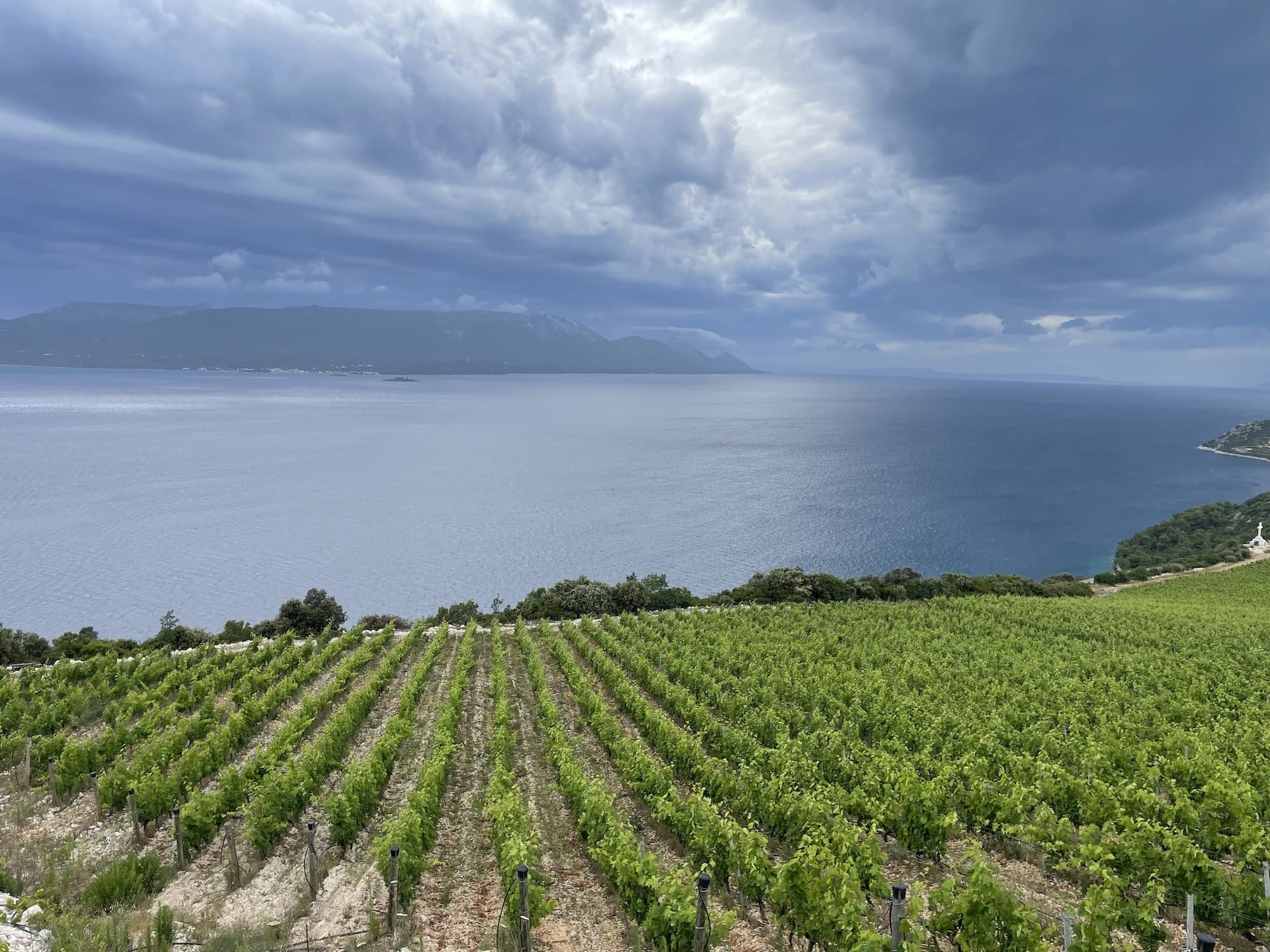
Dingač and Postup: the wine slopes of Pelješac
It means the area is legally bounded and the name may only be used for wine from that ground, made under prescribed conditions. Dingač became the first such protected position in Croatia in 1961, Postup a few years later. The protection attaches to the land, not to a producer.
The same grape, plavac mali, on adjacent slopes with different exposure. Dingač is further west and steeper, Postup further east and closer to Orebić, with a gentler gradient over part of it. We do not judge which wine is better; the difference that matters to a property buyer is how reachable the ground is.
Because the vineyards lie on the far side of the ridge from the village of Potomje, on the seaward face, and there was no other route. For centuries the harvest went over the ridge on donkeys or round by boat. The tunnel was driven in the early 1970s, is about four hundred metres long and single-lane.
No. A protected position is not reclassified as building land, so the slopes remain vineyards. Construction happens at the edges, on parcels outside the protected area. For a buyer that means narrow supply, but also a view that new building can hardly close.
You can. The wine road runs from Potomje through the tunnel to the viewpoint above Dingač and on towards Trstenik. The road is narrow and in places has no barrier, so drive carefully. The harvest is late August into September. Out of season some wineries open by arrangement, so call ahead.
From Vienna to Pelješac: buying property as an Austrian
Roughly 850 to 900 kilometres, realistically nine to ten hours, and about 750 from Graz. Since Croatia joined Schengen in January 2023 there is no border control on the way, and since 2022 the Pelješac Bridge bypasses the Neum corridor. It is an uninterrupted motorway drive as far as Ploče.
No. Croatia has used the euro since 1 January 2023, so no conversion takes place. The price in the listing and in the contract is in euro, as are taxes, notary and running costs. That is a noticeable difference from, say, Polish or British buyers.
As a rule no. Austrian banks do not usually lend against property abroad, and Croatian banks are reluctant to finance non-residents and ask for extensive documentation. Cash purchase or borrowing against a property in Austria are therefore the norm. Settle it before viewings begin.
It depends what you want. Istria is about five hours closer, better known, better served and more expensive. Pelješac costs less per metre by the sea, is far less built up and quieter, but has a shorter season and almost no infrastructure outside Orebić. If you want quiet and vineyards, drive on; if you want a short trip and amenities, stay north.
The double taxation treaty provides that income from immovable property is taxed in the state where the property is located, so in Croatia. How the Austrian side is settled depends on your residency and other income, which belongs with an Austrian tax adviser before you buy.
What you actually own when you buy an apartment in Croatia
It is your share of the building’s common parts and the weight of your vote on decisions. It is not the flat’s area divided by the building’s; it comes from the useful value, in which every space enters with a coefficient reflecting how usable it is. That is why terraces, stores and parking raise the share, and why two flats of the same size can hold different ones.
Not automatically. If a space is registered as storage, that is its permitted use however it looks and however it is used. Conversion is a separate administrative procedure and depends on the conditions for that building and zone, so check it before buying rather than assuming it. Until then such a space may not be advertised as a flat or as a letting unit either.
All the co-owners, in proportion to their shares, out of the reserve fund. If the fund is short, the difference is collected as an extraordinary levy. The decision is taken by share, which means the others can outvote you and you will contribute even if you were against it.
That is a question for the lawyer handling your purchase, because it depends on the circumstances and on how the co-owners’ agreement is drawn. What you can certainly do before signing is ask the manager for a statement of outstanding obligations on that unit. If nobody will produce one, that is information in itself.
It depends how much you want to decide and how much you want to maintain. A flat needs a smaller entry price and less attention, but you pay into the fund, share the decisions and cannot easily change what is held in common. A house gives you full control and the full cost. For letting, a front-row flat with parking often fills better than a larger house up the slope, and needs less managing.
Holiday letting on Pelješac: what it actually returns
You have to. Holiday letting requires a categorisation decision, guest registration in eVisitor, and payment of the tourist levy and flat-rate tax. Letting without them is an offence and inspections do happen. The property must also be lawful, since categorisation is not granted without an occupancy permit.
July and August are dependable, June and September good but not full, May and October uneven and weather-dependent, and from November to April there is effectively no demand. That is considerably shorter than Dubrovnik or Split, where the city itself draws visitors outside summer. Viganj is the exception, because wind shapes its season, so it starts earlier and lasts longer.
It depends on the platform and the model. Where the host carries the commission it is typically around fifteen percent or more, while on models where the guest pays part of the fee the host is charged a considerably smaller percentage. Commission comes off before every other cost, so always subtract it from gross turnover rather than from what is left.
Rarely. The season is too short and the costs too high for letting alone to return the investment. What does work on Pelješac is letting covering the cost of holding a house you want anyway. If the purchase depends on rental yield, that is a sign to look at the calculation again before signing.
A pool, by a clear margin, especially for properties not in the front row, because it lengthens the season. Then reaching a beach on foot, parking, air conditioning throughout and fast internet. Expensive finishes beyond a certain level barely register in the nightly rate.
What your property on Pelješac is actually worth
The valuation is free and carries no obligation. The visit takes about an hour, and you have a price range within a few days, the time needed to review the documents and compare against what actually sold in that village.
Because what your neighbour is asking is an asking price, not an achieved one. Beyond that, two apparently identical houses can differ sharply in access, elevation, the state of the paperwork and what may be built around them. Those differences usually explain the gap.
Small repairs and a thorough clean, yes. A major renovation just before a sale, generally not: it rarely returns what it costs and is usually done to your taste rather than the buyer’s. The money is better spent putting the paperwork in order and on good photographs.
Then the property cannot be sold until the heirs are established and registered in the land registry. That is no obstacle to talking to us; if anything it is a reason to start sooner, because the procedure can take a while. We can carry out the valuation before probate is finished.
You can; the owner sets the price. But it is worth knowing what follows: a listing draws most of its enquiries in the first two or three weeks, and that is the attention an overpriced property spends for nothing. Cutting the price later rarely recovers that initial interest.
A stone house to renovate: what you are buying and what comes next
Buildings put up before 15 February 1968 are treated as lawfully built, but that has to be evidenced by a certificate from the competent authority, issued from cadastral records and aerial photography. Anything added later is not covered by that certificate and needs its own permit or as-built decision.
As orientation, roughly 1,200 to 2,000 euro per square metre of internal area for a full renovation to a modern standard. The range is wide because access, structural condition and conservation requirements affect the price more than floor area does. Much lower figures usually mean a cosmetic refresh or an incomplete budget.
The usual reason is unresolved co-ownership. In Dalmatia it is common for probate never to have been completed, so the house legally belongs to a number of heirs, some living abroad and some no longer alive. A valid sale needs every co-owner, and gathering their consents can take years.
Not necessarily. If the house is in a protected historic area or individually listed, the works are approved by the regional conservation department. That usually means traditional barrel tile instead of modern tile, timber joinery instead of PVC, and no enlarging openings at will. Check the status before buying, not after.
It depends what you are buying. A stone house with a good position and clean paperwork often works out cheaper than a new build in the same spot, but only once a full renovation with a twenty percent contingency is in the budget. If you want something habitable without managing deadlines and contractors, a new build is the more honest option.
Buying property in Croatia as a Polish citizen: Pelješac in practice
No. Citizens of European Union states buy in Croatia on the same terms as Croatian citizens, without ministry consent and without setting up a company. You buy in your own name and are entered in the land registry as owner.
By car it is about 1,300 km from Kraków and 1,500 from Warsaw, realistically fifteen to seventeen hours, so usually two days. Since Croatia joined Schengen in 2023 there is no border check on the way, and the 2022 Pelješac Bridge bypasses the Bosnian stretch. By air, Dubrovnik is about two hours from Orebić and Split about three.
Usually not. Polish banks as a rule do not lend against property located abroad, and Croatian banks are reluctant to lend to non-residents. In practice Polish buyers pay cash or borrow against a property in Poland. It is worth settling before viewings begin.
The double taxation treaty between Poland and Croatia provides that income from immovable property is taxed in the state where the property is located, so in Croatia. How the Polish side is settled depends on your tax residency and other income, so consult a Polish tax adviser before buying with letting in mind.
It depends what you are after. Istria is about five hours closer to Poland, better known and more expensive. Pelješac costs less per metre by the sea, is far less built up and quieter, but has a shorter season and less infrastructure. If you want quiet and vineyards, Pelješac. If you want a short drive and developed amenities, Istria.
Usable and gross floor area: how to read the numbers in a listing
All of them are real, they simply measure different things. For comparing price per square metre, use the usable area, since it is the only one that weights outdoor space. Gross is useful when you want the total extent of the building, and the GBP from the permit serves administrative checks, not sales.
Because the permit states the gross building area, measured to the outer edges of the structure for checking against the spatial plan. Listings normally state the usable or gross area from the design, which are calculated differently. A difference of around ten percent between them is normal.
Usually not towards the headline figure. A pool is normally listed separately in the permit as an ancillary structure with its own gross area, while a garage falls within the basement area. So always check whether the figure in a listing includes those spaces.
Ask for the room schedule for both and work out the usable area yourself using the same coefficients. If you cannot get the schedule, at least ask whether the listed figure is enclosed space or includes terraces. Without that, comparing price per square metre is meaningless.
Buying off-plan in Croatia: how turnkey purchases work
That depends entirely on what the contract says. Which is why the contract must set deadlines, consequences of delay and how paid amounts are returned. Instalments tied to stages and a note in the land register limit your exposure, but none of that happens by itself: it has to be agreed before the first payment.
Formally, no. Without it the building has not been confirmed as built in accordance with its permit, so there is no proper registration, no residence registration and no categorisation for letting. That is why the final instalment should be tied to it.
When buying from a developer who charges VAT, no, because that would tax the same transaction twice. The other costs, notary, registration and lawyer, remain the same as on any other purchase.
Because the design states both gross and usable area. Usable applies a coefficient to outdoor spaces, so it is smaller. Neither is inaccurate, but comparing price per square metre only means something if both are calculated the same way.
Things to do in Viganj: the wind, the sea and life out of season
No. The wind is why Viganj is known, but the village works without a board: mornings are calm and good for swimming, Korčula is half an hour away via Orebić, and the Dingač wineries are over the hill. Schools run beginner courses if you are curious.
The maestral is strongest and most regular in July and August, when it blows on almost every afternoon. June and September offer good wind with considerably fewer people, which is why many regulars prefer them.
With caveats. The wind makes the sea choppier and colder in the afternoon than in sheltered bays, and the shore is shingle and rock. Mornings are calm and perfectly suitable, and for shallow, still water Trstenica in Orebić is a ten-minute drive.
Very little. Most hospitality and rental businesses close from November to April, and daily life leans on Orebić, ten minutes away. For a visitor that is a drawback; for a buyer it is information to have before deciding.
Buying a house by the sea in Croatia: a guide for DACH buyers
Yes, without restriction and without consent. As EU nationals they acquire on the same terms as Croatian citizens. Swiss nationals, as third-country nationals, are subject to a separate procedure based on reciprocity.
Yes. The Croatian tax number, the OIB, is a precondition for the sale contract and for registration. It is straightforward to obtain and can be done by an authorised representative, so it does not require a trip of its own.
Yes. With a certified power of attorney the whole process can be handled without you travelling. We still recommend seeing the property yourself once, and outside the high season.
It is possible but not usual. Loans to non-residents generally carry poorer terms and longer processing than financing at home. Most buyers finance at home and buy in Croatia for cash, which also improves their negotiating position.
Building land on Pelješac: how to tell it apart
On its own it means nothing. The cadastral entry describes how the land is used; whether you may build is determined solely by the spatial plan. A vineyard inside a construction zone can be buildable, and a yard outside one cannot. Check the confirmation of land use.
The confirmation of land use, issued by the competent administrative department for physical planning on the basis of the spatial plan in force. A listing, a seller’s word and a cadastral extract are not proof.
You can, but that is speculation, not a plan. Reclassification happens through an amendment to the municipal spatial plan, takes years, applies to whole areas and can end with no change to your plot. Never pay a price that assumes it will happen.
Not necessarily. Existing construction is often older than the current rules or was legalised after the fact, and a stricter regime applies along the coast. What stands next to your plot is no proof of the permit you would be granted today.
Yes, a serious one. Without legally resolved access from a public road, no building permit is issued. A track people have driven for years is not resolved access, and sorting it out afterwards depends on the consent of whoever owns the land it crosses.
Things to do in Orebić: the town, the surroundings and life out of season
June and September. The sea is warm, everything is open, and both crowds and prices are well below July and August. If you want to see what the place is really like, come out of season.
Not to stay in the town itself, which is easily walkable. Yes for Dingač, Ston, the further coves and any trip around the peninsula. In summer, expect to hunt for parking in the centre.
By passenger boat or car ferry across the channel, several times a day, and the crossing is short. Timetables depend on the season, so check on the day. For sightseeing in the old town the passenger line is simpler than taking a car.
Yes, and that sets it apart from most places on Pelješac. A school, a clinic, shops and several places to eat stay open all year, and ferries and buses keep running through winter. There is less on offer than in summer, but the town does not shut down.
The cost of buying property in Croatia in 2026
Yes. The rate is the same 3 percent as for a house or apartment, calculated on the market value of the plot. With land the fixed costs make up a larger share of the total, because the base is smaller.
The buyer. The tax is the obligation of the party acquiring the property and is paid once you receive the assessment from the tax authority. The seller has no part in this item.
No. Commission is a separate item, agreed per contract and always in advance, before the first viewing. Budget for it separately from the price of the property.
Yes. With a power of attorney certified by a notary or at a Croatian consulate, the entire process can be completed without you travelling, payments included. Budget for a slightly higher notary cost on account of the power of attorney itself.
Let's find your dream property on Pelješac, Croatia.
Get in touch. A quick consultation costs nothing and saves months of searching.